Application & Construction
Zoerobot, XbotPark Robotics Base, Dongguang, Guangdong, China
Robotic AAC panel installation comes of age in Singapore
Loading...Singapore's labour arithmetic
Compared with bricks and blocks, autoclaved aerated concrete (AAC) wall panels have become increasingly popular because they enable faster wall installation. What hasn't changed is how the panel gets from the pallet to the wall. On a conventional site, it is cut with hand tools, moved by forklift or manually piece by piece, then lifted, tilted and aligned manually beneath the beam soffit. The panel is lighter for the building, but not for the workers holding it at head height.
In Singapore, that has become an acute problem. As of December 2025, non-residents accounted for close to four in five of the 566,800 people working in construction, and in 2025, construction labourer was the single largest non-PMET job vacancy across all sectors. Contractors report competing for the same workers with other countries, while local recruitment remains negligible.
The response has been unusually direct. Building and Construction Authority figures show more than 25 types of robot now deployed across roughly 60 projects, compared with virtually none in 2022. JTC Corporation has made robotics compulsory in its construction tenders since late 2025. Sixteen of the 31 Build-To-Order projects tendered by the Housing Board since 2025 will adopt robotic solutions. And the Land Transport Authority has mandated robotics to replace specific manual operations on its MRT projects – the first time the agency has required robots to replace a defined manual trade.
The project
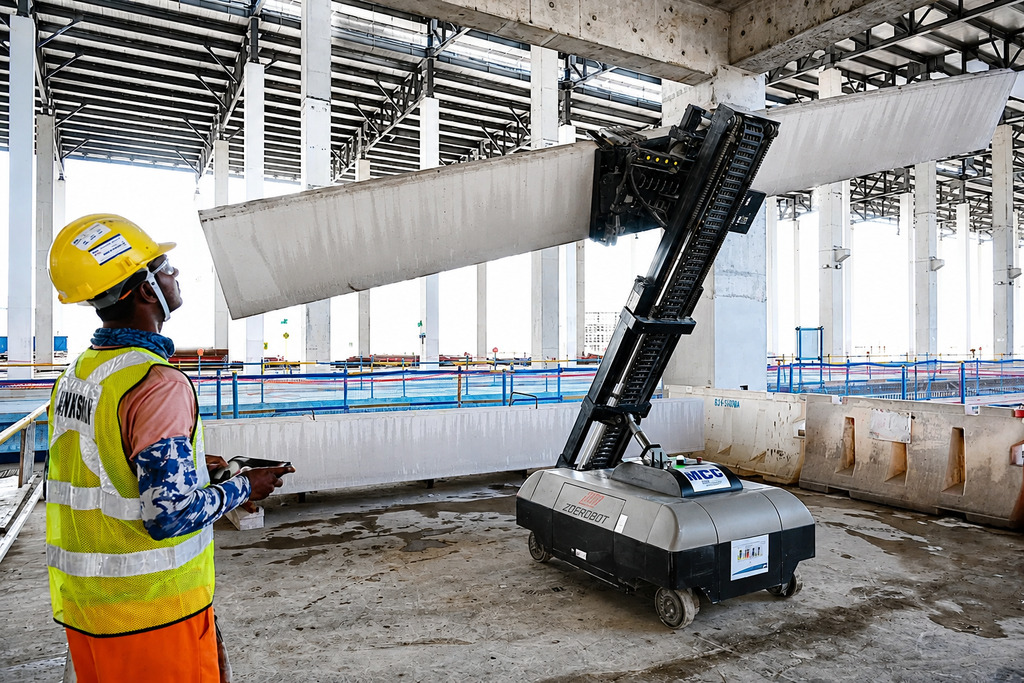
Zoerobot’s Campa-600 wall panel installation robot has been deployed on the Singapore Changi East Depot project, with a scope of more than 200,000 square metres of AAC wall panels. It began work there in July 2025 and has been in continuous service for over a year.
That figure matters more than any demonstration. A trial proves a robot can work. A year of operation with temporary power, changing floor layouts, materials stacked wherever they happened to land and floors that are rarely flat demonstrates that it can keep working – and directly addresses one of the most common complaints contractors make about imported construction robots: support and service can evaporate once a robot arrives on site.
How the work changes
The panel is stood on edge and raised clear of the floor. The operator brings the robot square to the panel face, lowers the lifting mechanism until the upper stop seats against the top edge, and clamps the lower jaw. The robot lifts roughly 500 mm to free the panel from the stack, closes the upper jaw, travels clear, then rotates the panel through 90 degrees to vertical. At the wall, it is raised to within 5 to 10 mm of the beam soffit, aligned to the ink line by cross-transfer, and released once it is in contact with the adjacent panel. Fixings go in by hand.
A panel takes about six minutes. The crew consists of two people, neither of whom lifts anything, and neither of whom stands in front of the robot or beneath a suspended panel. Operator training and assessment take one day.
The productivity outcome
The clearest published figures come from the Land Transport Authority (LTA), reported by Lianhe Zaobao in July 2026. Measuring AAC partition wall installation on its own projects, LTA recorded that a worker using conventional methods completed approximately 0.034 square metres of wall area per man-hour. With the panel installation robot handling transport, erection, alignment and installation under remote control, the same work reached approximately 0.096 square metres per man-hour – 2.8 times the manual rate.
LTA's assessment went beyond output, noting that automation improves installation precision, reduces human error, and eliminates heavy lifting entirely, thereby mitigating the risk of long-term workplace injuries. On that basis, the technology is being extended to Cross Island Line Phase 2 and the Cross Island Line Punggol Extension, and under Singapore's CTIPS framework, contractors pledging higher technology adoption now score better in the tender process.
Zoerobot's Campa series
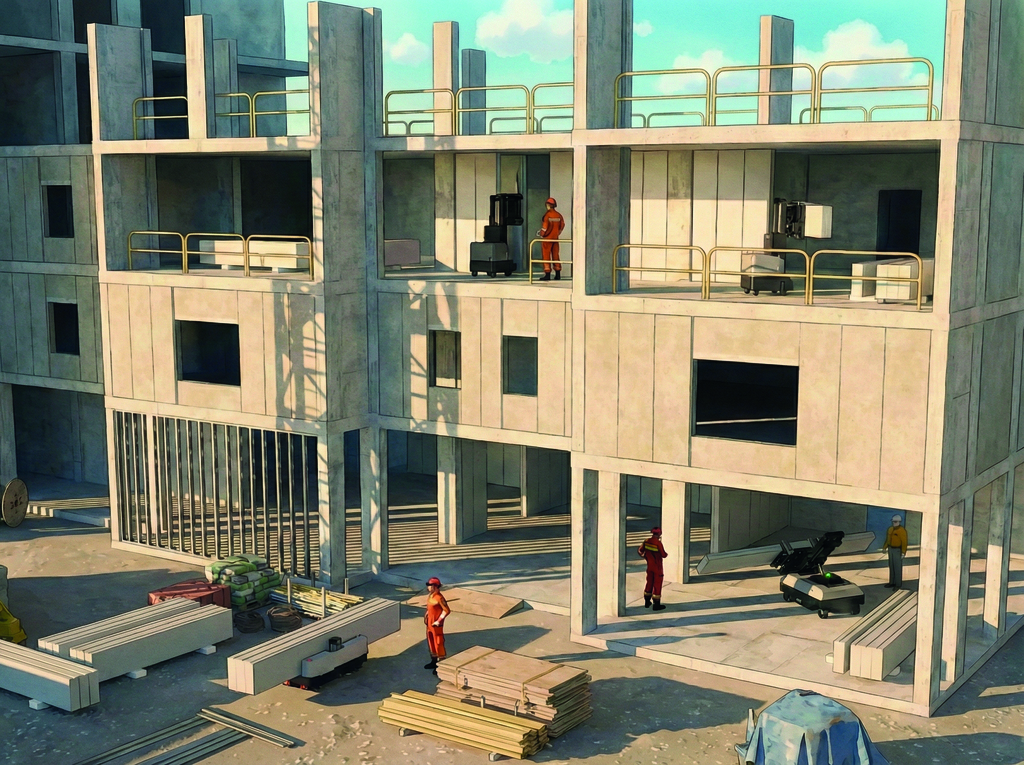
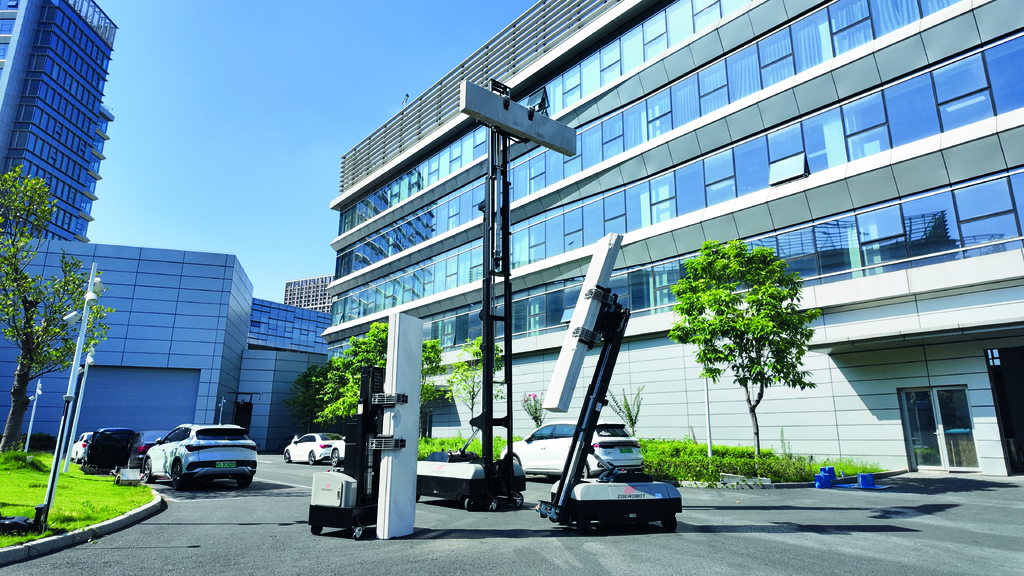
Along with the Campa-600, Zoerobot recently introduced the Campa-300 and the Campa-1200. All three robots in the Campa range are built on a common platform and operate in the same way. Each is driven wirelessly from an industrial tablet, so the panel is picked from the stack, carried, rotated and placed without a hand laid on it and without anyone standing beneath it. Lifting, translating, pitching and rotating are all servo-controlled on a fully electric drivetrain with no hydraulics – a deliberate choice that removes pressurised circuits, cylinder rupture and hose failure from the risk register and provides finer control during placement. Each robot runs an omnidirectional four-wheel-drive chassis with a zero-radius turn and a dual-claw gripper that holds the panel at two independent points. Gripper sets cover panel thicknesses from 75 to 250 mm.
The Campa-600 proved the method in Singapore. It handles panels of 3 to 6 m and loads to 600 kg, measures 1600 × 1200 × 1800 mm, weighs 1200 kg, crosses 50 mm obstacles and runs a full eight-hour shift on one charge. The company has since introduced two further robots to the market, extending the same control system and operating method to both ends of the range.
Campa-300: into the tighter spaces
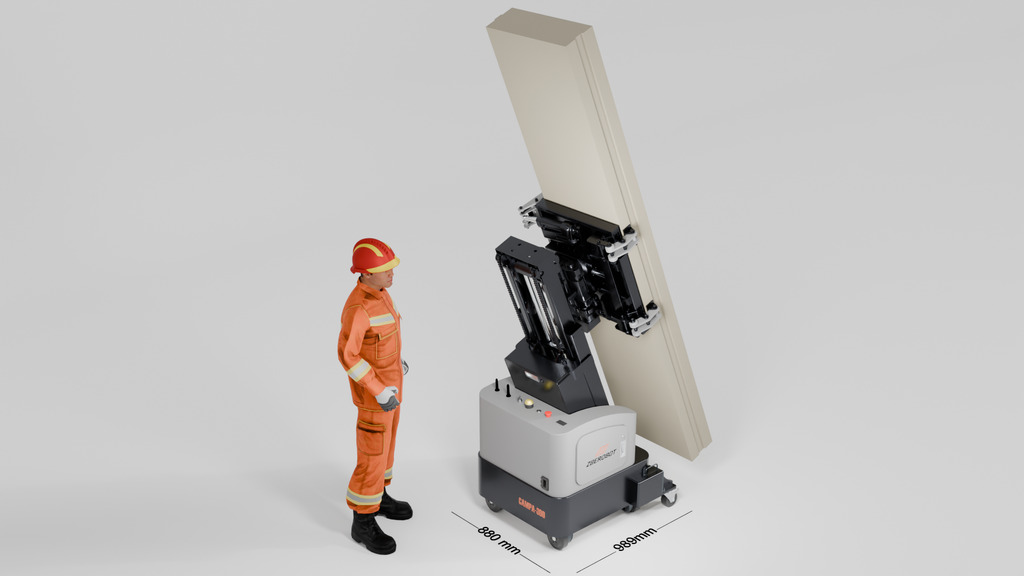
The Campa-300 handles panels of 2 to 3.2 m and up to 300 kg. At 880 × 989 × 1360 mm and 800 kg, it is small enough to pass through standard door openings and to travel in passenger-sized hoists, making it suitable for residential floor plates, hotel and apartment fit-out projects, and refurbishment work in occupied buildings. It brings robotic installation to projects where the Campa-600 simply cannot be manoeuvred and is operated by the same trained personnel using the same tablet application.
Campa-1200: building the tallest walls
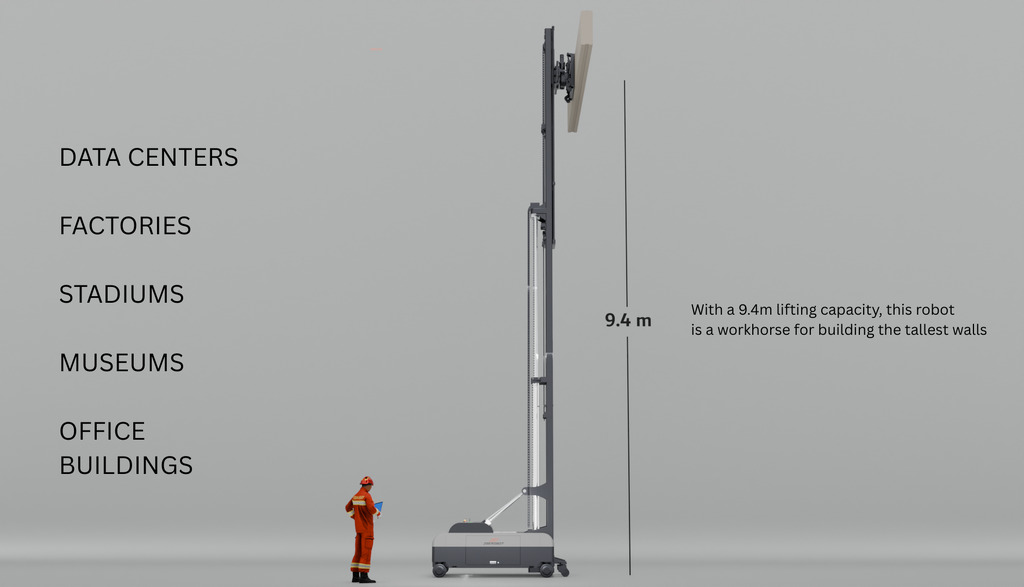
At the other end of the range, the Campa-1200 lifts to an installation height of 9.4 m, for panel assemblies up to 12 m. That reach opens up building types where partition and infill walls are simply too tall to be installed manually at a reasonable rate: data centres, factories and industrial halls, stadiums, museums and large office buildings. It is the workhorse of the range, extending robotic installation into the part of the market that has remained stubbornly manual because no equipment could previously reach it safely.
From one site to a fleet
Zoerobot has delivered close to 100 wall panel installation robots, approximately 20 of them working outside China – in Singapore, the United Arab Emirates and Hong Kong.
What Singapore demonstrates is not merely that a robot can install wall panels quicker, safer and cheaper. It demonstrates that robots can operate reliably under real site conditions for extended periods, that a public authority is prepared to measure the gains and publish them, and that, having measured them, the authority is prepared to make robotics technology a condition of tender. For an industry that has spent twenty years making a better panel, installation has finally started to catch up – and Zoerobot is clearly riding the wave.
References
https://www.zaobao.com.sg/news/singapore/story20260706-9314783
Ich kann im Redaq gerade keine neue Adresse anlegen, daher hier die Adresse:
((Logo Zoerobot - besorge ich noch))
Zoerobot
XbotPark Robotics Base, 11 University Road, Songshanhu Administration Committee
Dongguan, Guangdong, China
T +86 180-2515-2315
zoerobot@zoerobot.com
www.zoerobot.com