Production Technology
Keda Suremaker, Maanshan City, Anhui Province, China
Digital systems for coordinated AAC production
Loading...Keda Suremaker’s digitalisation approach brings these activities together through five connected modules: automatic recipe management, production scheduling, overall equipment effectiveness, energy management and production traceability. The system description combines PLC/DCS-based process execution with manufacturing execution system (MES) coordination and plant-level monitoring. Functions and interfaces are configured around the equipment, instruments and production requirements of the individual plant. The following examples explain this operating approach; they do not present a measured plant-performance comparison.
Executing recipes at the batching stage
The proportions of sand or fly ash, lime, cement, gypsum, aluminium and water influence slurry behaviour, gas formation and green-cake development. Recipe management therefore has to carry an approved formulation into repeatable weighing, dosing and mixing operations. Keda Suremaker automatic recipe system combines PLC/DCS control, weighing modules, online density measurement and material-handling actuators with the production-management platform. This arrangement supports automatic recipe recall, material metering, dosing sequence and execution of mixing settings.
A recipe library supports products with different density targets and the change between blocks and panels. Each mould batch can retain its associated recipe and dosing records for subsequent review. The batching HMI (Human Machine Interface) in Figure 1 shows the physical relationship between material storage, dosing routes and mixing equipment, placing process controls beside the relevant equipment rather than separating them into an unrelated list.
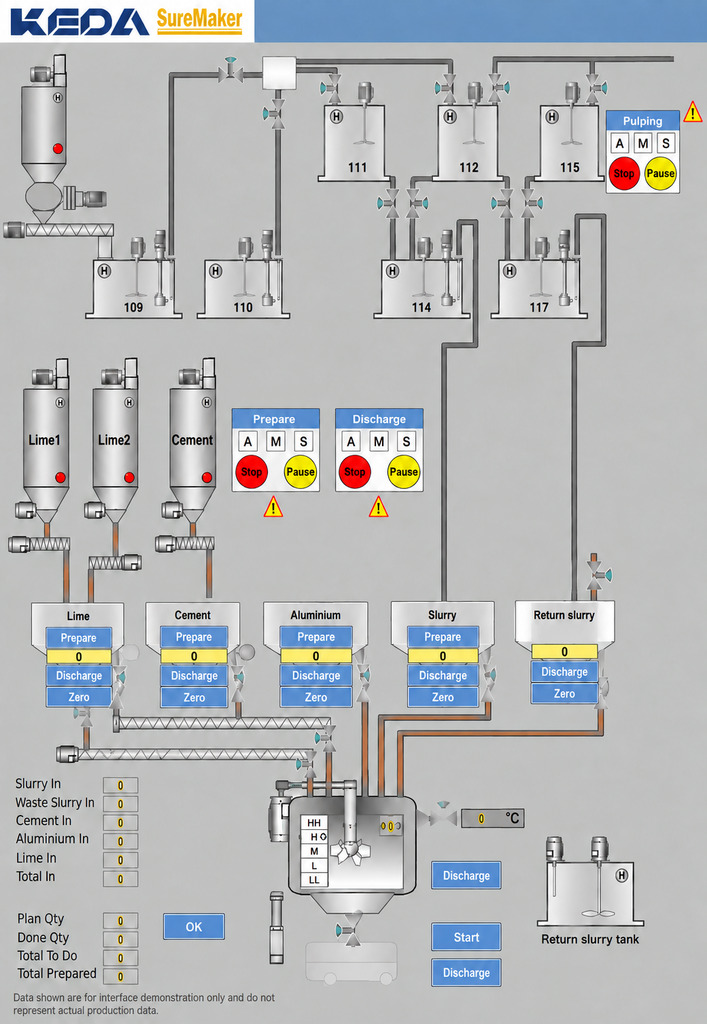
Slurry introduces both solids and water into a batch. Where the necessary measurements and material relationships have been established, the calculation can account for the solids contribution and water already carried by the slurry. Keda Suremaker describes adaptive recipe correction as an advanced configuration, using current raw-material indicators to adjust component proportions. Such correction requires validated material data and operating limits. Linking the resulting batch records to casting, pre-curing and autoclaving provides a basis for reviewing how the selected formulation behaved in production.
Turning orders into coordinated production tasks
Scheduling starts with orders, but its practical output is a sequence that the plant can execute. Keda Suremaker MES scheduling module uses sales orders, production resources and process constraints to generate casting mould-batch plans, grouping plans and autoclave-loading plans. Relevant resources include moulds, batching lines, cutting equipment, autoclaves and storage capacity. Reinforced panels also require coordination with reinforcement preparation. Tasks can then be dispatched to batching, casting, cutting, autoclaving and warehousing operations.
The mould-planning interface in Figure 2 makes part of that planning output visible. The planned number of casting batches (mould batches) and the corresponding number of individual panels or blocks are shown alongside graphical product arrangements. A mould batch refers to one casting in a mould; its cake is subsequently cut into multiple product pieces. Grouping compatible orders can reduce unnecessary specification changes, while checking mould and autoclave availability helps avoid conflicting resource assignments. These decisions must also respect approved pre-curing and green-cake handling windows: maximising the load is only beneficial if the resulting production sequence can still be handled efficiently by the preceding and subsequent process steps.
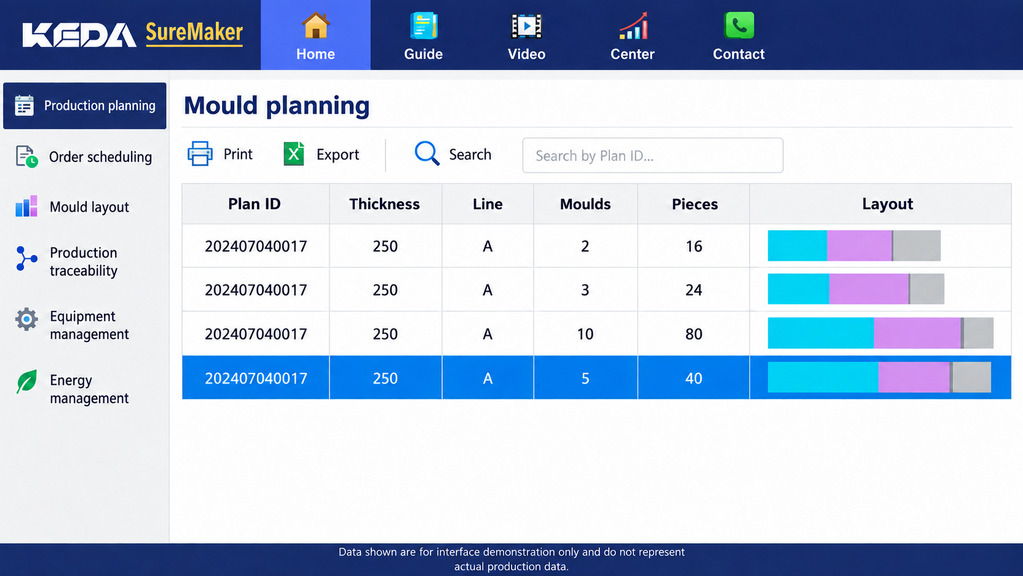
Linking scheduling with recipe, equipment and progress information gives production and sales teams a shared basis for reviewing order changes. A revised sequence can be checked against downstream loading and storage requirements, while waiting, changeover and fault records reveal constraints that should inform later plans. The objective is to coordinate delivery commitments with the actual production route and available resources.
Using equipment losses to guide improvement
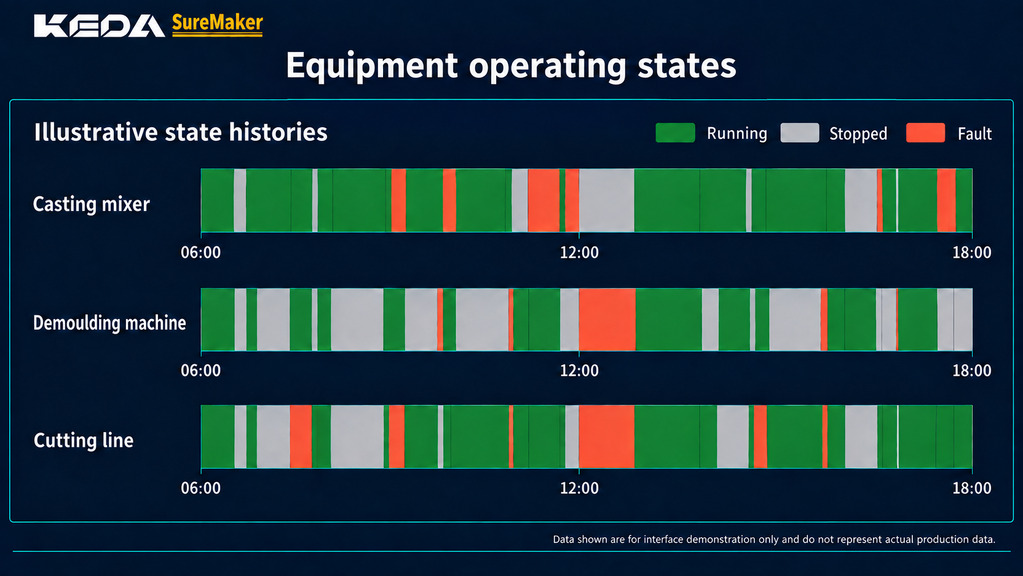
Keda’s equipment-management module combines asset records with operating-state data acquired through PLCs, sensors and the MES. It supports automatic classification of time losses and calculation of overall equipment effectiveness (OEE) and its components: availability, performance and quality. Figure 3 illustrates the underlying state-history view. It distinguishes running, stopped and fault periods, providing a starting point for examining where production time was lost.
A fault stop and an otherwise available machine waiting for upstream material call for different responses. Separating these causes helps direct maintenance towards recurring faults and scheduling improvements towards organisational losses. Fault frequency and history can support preventive maintenance; linking equipment events with rejected product records also supports investigation of quality problems. OEE comparisons require consistent definitions of planned time, reference production rate and accepted output. State timelines alone do not establish the complete OEE result.
Connecting energy measurement with corrective action
The energy-management approach begins with metering at plant, production-area and equipment level. Electricity, water and steam meters, together with temperature and pressure measurements, feed records that can be organised by production line, autoclave cycle, shift and reporting period. Monitoring views show consumption patterns and specific-consumption trends, while comparisons with historical records or defined limits help identify conditions requiring investigation. The autoclave view in Figure 4 places equipment within a common monitoring environment.
Keda’s description also includes threshold-based alerts for conditions such as abnormal steam pressure, excessive supply, idle electricity consumption and sudden increases in demand. Alerts prompt production and maintenance personnel to investigate, correct and review the event. This monitoring–alert–action–review sequence gives energy management an operational role. Evaluating the result requires consistent metering boundaries and an allowance for changes in output and product mix.
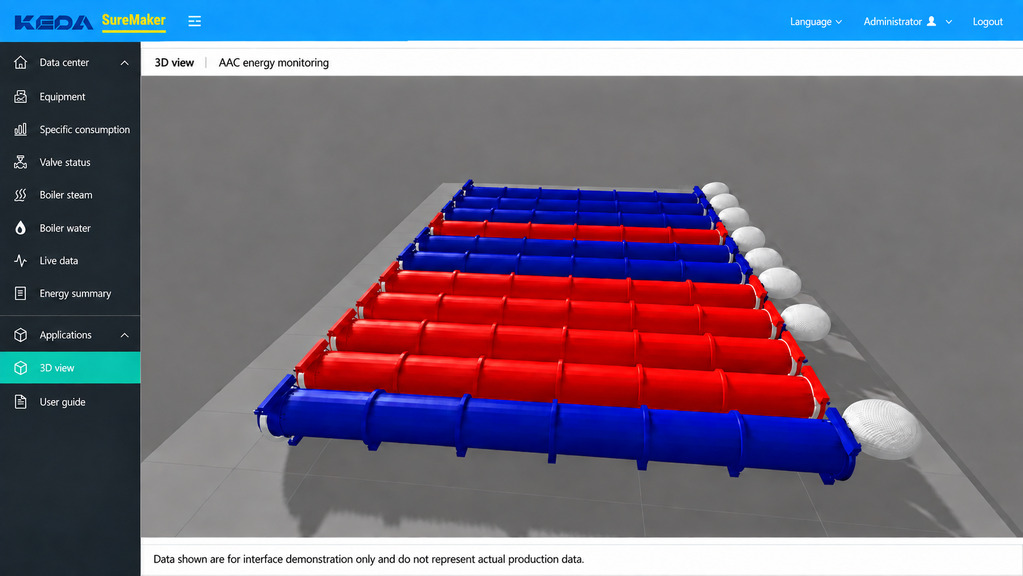
Associating energy records with recipes and curing conditions creates a basis for reviewing steam-supply strategies, equipment start and stop logic, and opportunities for heat and condensate recovery. More advanced modelling depends on dependable data linking material characteristics, temperature, pressure and curing duration to product quality and energy use. Any revised curing regime must satisfy the required product performance.
Preserving the relationship from materials to finished products
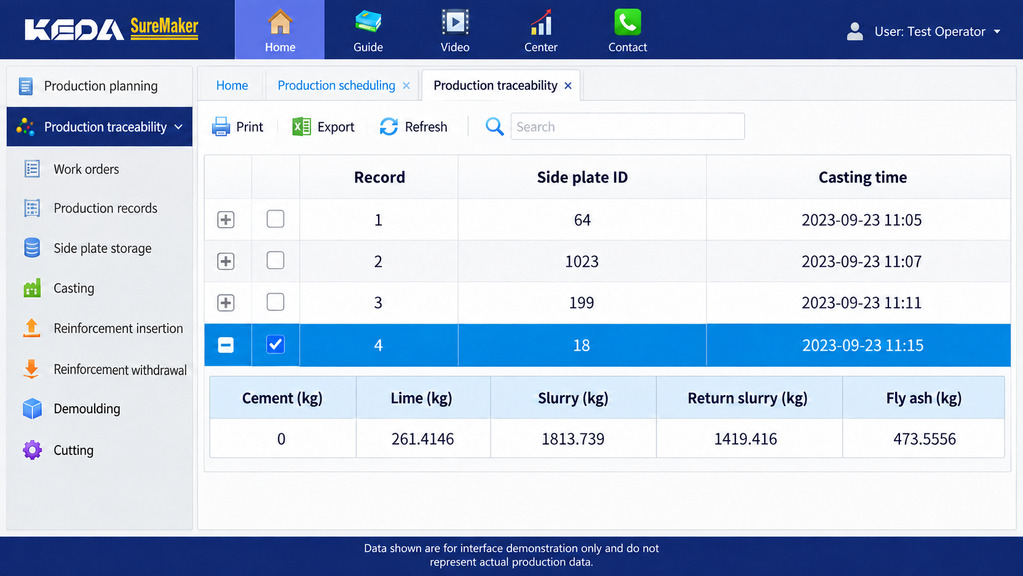
Traceability provides the connection across these modules. Keda’s MES approach uses mould identifiers, cake identifiers, batch codes and finished-product barcodes to associate raw materials, recipes, schedules, equipment states, autoclave records, energy data and inspection results. This supports forward queries from incoming materials to dispatched products and reverse queries from a finished product to its production history. Identifiers must preserve these relationships when moulds are reused and cakes are divided into individual products.
Figure 5 shows a direct example: expanding a production record reveals its associated ingredient quantities. At a wider scale, a suspect raw-material batch can be used to retrieve the corresponding mould batches and finished products for containment review. Conversely, a reported product defect can initiate a review of its material, processing and equipment records. These records support investigation and the selection of checks; process knowledge and verification remain necessary to establish the cause.
Retained histories also support process review across batches and the preparation of production documentation for downstream construction projects. Their usefulness depends on complete links between material batches, process events and inspection results. Bringing this information together gives quality, production and customer-service teams a common reference when reviewing a product or assessing a proposed process change.
Building lasting manufacturing capability
For Keda Suremaker, the long-term value of AAC digitalisation lies in connecting recipe execution, production scheduling, equipment management, energy use and product traceability into a system for continuous improvement. Translating process knowledge into executable parameters, making deviations available for review and documenting corrective actions creates a foundation for more consistent product quality, more effective resource use and more reliable delivery.
This value also extends beyond the factory. Traceable production histories can support quality-related communication between manufacturers and construction projects, while transparent material and energy records provide a verifiable starting point for resource-efficiency and emissions-reduction initiatives. By bringing equipment and process knowledge into its digital systems, Keda Suremaker aims to help AAC manufacturers build repeatable, measurable and continually improving manufacturing capability in support of the construction sector’s need for reliable products and responsible production.